A small but unusually concentrated archive of internal reports, memoranda, correspondence, organizing proposals, and advocacy material documenting the institutional machinery of the American antiwar movement at the end of the 1960s, with substantial representation of Clergy and Laymen Concerned About Vietnam (CALCAV), the Council for Christian Social Action (CCSA) of the United Church of Christ, and Business Executives Move for Vietnam Peace (BEM). The papers appear to have been assembled or retained by Dr. Thomas Brewster Manton, then working within the international-affairs and progressive-church milieu centered at the Church Center for the United Nations, 777 United Nations Plaza, New York.
What initially appears to be a compact group of Vietnam-era organizational papers becomes considerably more interesting when considered through Manton. The identification of the recipient is now compelling: a November 21, 1969 letter is addressed to “Mr. Tom Manton” at the Church Center for the U.N., 777 United Nations Plaza, and discusses Manton's efforts to obtain a visa for travel to China. Thomas Brewster Manton was an international-relations scholar whose 1968 doctoral dissertation was a political biography of UN Secretary-General U Thant and who became a founder and leading organizer of the Committee for a New China Policy, itself operating from 777 United Nations Plaza. The conjunction of name, address, CALCAV connection and China activity makes the identification highly persuasive and reveals that Manton's emerging China-policy work was already known within this progressive religious network by November 1969.
The archive captures a particular moment when organized religious opposition to the Vietnam War was developing into a broader critique of American foreign policy and domestic institutions. Its recurring subjects—Vietnamization, imperialism, Third World liberation, draft resistance, military service, youth radicalization, racism, corporate power, institutional Christianity, grassroots organizing and fundamental change in American foreign policy—give the group an intellectual and documentary coherence considerably greater than its modest size might suggest.
At its center is CALCAV's five-page Local Organizing Project, November 1969, an exceptionally substantive internal planning document produced just as news of the My Lai massacre was entering American public consciousness. Rejecting Nixon's Vietnamization policy as a continuation of the Johnson administration's underlying assumptions, the report argues that the struggle must ultimately extend beyond Vietnam toward nationalism, self-determination, economic independence for developing nations and the “reshaping of the United States foreign policy in the future.” It provides a remarkable operational snapshot of CALCAV itself: 31,200 members, nineteen full- and part-time field staff, sixty-eight additional affiliated groups, and an explicit strategy for mobilizing churches and synagogues while maintaining contact with conscientious objectors, draft resisters and servicemen.
Most revealing is its blueprint for sixteen organizing conferences during March–April 1970, intended not as mass demonstrations but as mechanisms for creating permanent local antiwar constituencies. Twenty prospective cities are identified, many deliberately outside the movement's familiar coastal and university centers, with projected attendance, organizational methods and a complete $28,250 national budget. Here is the antiwar movement not as public spectacle but as infrastructure: membership, staffing, geography, financing and the deliberate conversion of dissent into durable political organization.
A second major CALCAV planning document carries that organizational story directly into 1970: Richard R. Fernandez's three-page A Proposal for Local Field Staff Development by Clergy and Laymen Concerned About Vietnam, submitted to the Joint Strategy Action Committee in January, and accompanied by a typed cover letter on CALCAV stationery stamped “Jan 26 Rec’d.” Fernandez looks back to his work as co-director of the 1967 Vietnam Summer project in New York and describes CALCAV's subsequent attempt to construct a permanent national grass-roots field operation. He records more than 350 committees throughout the country and over 100 people engaged in full- or part-time activity, while acknowledging the difficulty of maintaining effective communication between the national organization and its increasingly numerous local workers.
Fernandez's proposal is unusually revealing about the professional infrastructure underlying movement politics. A network of regional field staffs covering twenty-one cities is envisioned, while particular attention is given to the problem of financing organizers. Approximately $65,000 in individual gifts had supported field operations during the preceding four years, but Fernandez proposes a more systematic arrangement under which local committees would raise designated funds administered through the national organization, enabling field workers to receive salaries together with such institutional benefits as Social Security and hospitalization. The program could begin with approximately $30,000, with an eventual projected annual cost of $125,000. Read beside the November Local Organizing Project, the proposal supplies the other half of CALCAV's expansion strategy: not merely where and how new constituencies were to be organized, but how the organization intended to recruit, finance and sustain the professional field staff necessary to do it.
Closely related is a CALCAV report on regional conferences, accompanied by a typescript cover letter signed by Richard R. Fernandez as Director. The autograph signature is a meaningful feature in an archive otherwise largely composed of institutional working papers, providing a direct connection to one of CALCAV's principal administrators. Together, the Local Organizing Project, Fernandez's Proposal for Local Field Staff Development, and the regional-conference material form an unusually coherent documentary sequence: expansion strategy, staffing and financing, and the practical development of a national organizing network. The CALCAV material consequently preserves not simply antiwar rhetoric but the mechanics by which a major peace organization attempted to convert the extraordinary mobilization of 1969 into permanent political organization. Fernandez's signed correspondence materially strengthens this component.
Equally striking is the five-page CCSA Youth Task Force Report, apparently the original ribbon typescript rather than a carbon, typed on thin translucent typing paper. Physical examination under magnification—the character impressions, variable ink deposition and especially the overstruck correction visible in the word “Christian”—supports that formulation while stopping appropriately short of an absolute assertion..
Its contents are unusually forceful for an internal denominational document. Written from the standpoint of the “under thirty” generation, the report complains that the CCSA has dealt only peripherally with the issues forming “the gut” of the youth movement and demands greater participation by young activists in the Council's strategy and decision-making. Under headings including “Imperialism,” “Systematic Analysis,” “Revolution,” “Confrontation Politics,” and “The Church and Social Change,” it attacks American interventions in Vietnam, the Bay of Pigs, the Dominican Republic, Okinawa and Guatemala; discusses the CIA's role abroad; characterizes America as a counter-revolutionary force; and questions whether the church functions as a prophetic agent of change or merely as “religious cement for the status quo.” Its subjects broaden further to poverty, racism, militarism, male chauvinism, corporate exploitation, ecology and population.
The CCSA material is complemented by a memorandum from John Robert Kernodle Jr., then a young figure operating at the intersection of Christian social action, law and the emerging progressive UCC. In the context of the archive, the memorandum provides further evidence of a younger generation pressing denominational social-action structures toward more direct engagement with contemporary political questions
Another component moves outside the churches while retaining the same coalition politics: a packet from Business Executives Move for Vietnam Peace, comprising a December 17, 1969 circular letter with facsimile signature of Robert A. Maslow; a two-sided sheet containing ten one-minute radio announcements; and a contemporary offprint of Peter Barnes's “The ArmyMay Be Hazardous to Your Health,” from The New Republic, December 10, 1969. The radio campaign enlisted the voices of retired Rear Admiral Arnold E. True, former Federal Reserve chairman Marriner S. Eccles, and Nobel laureate George Wald. BEM's printed roster demonstrates the remarkable breadth of establishment opposition to the war, extending from business executives to military and diplomatic sponsors including General David M. Shoup, John Kenneth Galbraith, Roger Hilsman, Edwin O. Reischauer, and Benjamin V. Cohen. It is an excellent surviving example of an effort to contest administration policy through the deliberately respectable voices of American business, military, scientific and diplomatic elites.
Finally, the archive contains the document that now supplies its strongest personal key: a typed letter signed from John B. Foster, Professor of English at Mankato State College, to Tom Manton, November 21, 1969, addressed directly to the Church Center for the U.N. at 777 United Nations Plaza and bearing a November 24 received stamp. Foster explains that Richard Killmer of CALCAV has told him that Manton is attempting to obtain a visa for China. Having lived in China from 1934 to 1937 and hoping to return during a forthcoming sabbatical, Foster asks Manton for advice.
In isolation this would be an interesting letter concerning the formidable difficulties of American travel to the People's Republic before Nixon's opening to China. Within the archive it performs a second and more important function. The conjunction of Tom Manton, the precise 777 United Nations Plaza address, CALCAV referral, and contemporary efforts to reach China makes identification with Dr. Thomas Brewster Manton highly persuasive. It also establishes that the China-policy activity which would shortly become a defining feature of Manton's public work was already intersecting with the religious antiwar network represented by these papers.
Taken together, the archive documents something broader than opposition to the Vietnam War. It records the institutional migration of dissent: from clergy protest to national grassroots organization; from denominational social action to generational challenges from within the churches; from conventional liberal criticism to discussions of imperialism and revolutionary change; from the peace movement into corporate and establishment opposition to the war; and, in Manton's case, toward the reconsideration of America's entire postwar relationship with Communist China.
The physical character of the material adds considerably to this effect. These are not retrospective accounts or later collections of published ephemera but working documents—mimeographs, typescripts, internal reports, received copies, signed correspondence and advocacy material—preserved from within the organizational network itself. The apparently original ribbon copy of the CCSA Youth Task Force Report, Fernandez's signed CALCAV correspondence, received stamps, and the Foster-to-Manton letter give the group the documentary texture of papers actually circulating among participants.
Provenance: apparently the papers of, or papers retained by, Dr. Thomas Brewster Manton.
A remarkably concentrated primary-source archive of the progressive religious and institutional antiwar movement at the threshold of the 1970s, particularly strong in CALCAV's internal organizing strategy, staffing and financing; the radicalization of Christian social action; generational conflict within the UCC; establishment opposition to Vietnam; and the emerging movement to reconstruct American policy toward the People's Republic of China.
Varying conditions, with age and handling-related wear as expected. Additional images and information available upon request.
A small but unusually concentrated archive of internal reports, memoranda, correspondence, organizing proposals, and advocacy material documenting the institutional machinery of the American antiwar movement at the end of the 1960s, with substantial representation of Clergy and Laymen Concerned About Vietnam (CALCAV), the Council for Christian Social Action (CCSA) of the United Church of Christ, and Business Executives Move for Vietnam Peace (BEM). The papers appear to have been assembled or retained by Dr. Thomas Brewster Manton, then working within the international-affairs and progressive-church milieu centered at the Church Center for the United Nations, 777 United Nations Plaza, New York.
What initially appears to be a compact group of Vietnam-era organizational papers becomes considerably more interesting when considered through Manton. The identification of the recipient is now compelling: a November 21, 1969 letter is addressed to “Mr. Tom Manton” at the Church Center for the U.N., 777 United Nations Plaza, and discusses Manton's efforts to obtain a visa for travel to China. Thomas Brewster Manton was an international-relations scholar whose 1968 doctoral dissertation was a political biography of UN Secretary-General U Thant and who became a founder and leading organizer of the Committee for a New China Policy, itself operating from 777 United Nations Plaza. The conjunction of name, address, CALCAV connection and China activity makes the identification highly persuasive and reveals that Manton's emerging China-policy work was already known within this progressive religious network by November 1969.
The archive captures a particular moment when organized religious opposition to the Vietnam War was developing into a broader critique of American foreign policy and domestic institutions. Its recurring subjects—Vietnamization, imperialism, Third World liberation, draft resistance, military service, youth radicalization, racism, corporate power, institutional Christianity, grassroots organizing and fundamental change in American foreign policy—give the group an intellectual and documentary coherence considerably greater than its modest size might suggest.
At its center is CALCAV's five-page Local Organizing Project, November 1969, an exceptionally substantive internal planning document produced just as news of the My Lai massacre was entering American public consciousness. Rejecting Nixon's Vietnamization policy as a continuation of the Johnson administration's underlying assumptions, the report argues that the struggle must ultimately extend beyond Vietnam toward nationalism, self-determination, economic independence for developing nations and the “reshaping of the United States foreign policy in the future.” It provides a remarkable operational snapshot of CALCAV itself: 31,200 members, nineteen full- and part-time field staff, sixty-eight additional affiliated groups, and an explicit strategy for mobilizing churches and synagogues while maintaining contact with conscientious objectors, draft resisters and servicemen.
Most revealing is its blueprint for sixteen organizing conferences during March–April 1970, intended not as mass demonstrations but as mechanisms for creating permanent local antiwar constituencies. Twenty prospective cities are identified, many deliberately outside the movement's familiar coastal and university centers, with projected attendance, organizational methods and a complete $28,250 national budget. Here is the antiwar movement not as public spectacle but as infrastructure: membership, staffing, geography, financing and the deliberate conversion of dissent into durable political organization.
A second major CALCAV planning document carries that organizational story directly into 1970: Richard R. Fernandez's three-page A Proposal for Local Field Staff Development by Clergy and Laymen Concerned About Vietnam, submitted to the Joint Strategy Action Committee in January, and accompanied by a typed cover letter on CALCAV stationery stamped “Jan 26 Rec’d.” Fernandez looks back to his work as co-director of the 1967 Vietnam Summer project in New York and describes CALCAV's subsequent attempt to construct a permanent national grass-roots field operation. He records more than 350 committees throughout the country and over 100 people engaged in full- or part-time activity, while acknowledging the difficulty of maintaining effective communication between the national organization and its increasingly numerous local workers.
Fernandez's proposal is unusually revealing about the professional infrastructure underlying movement politics. A network of regional field staffs covering twenty-one cities is envisioned, while particular attention is given to the problem of financing organizers. Approximately $65,000 in individual gifts had supported field operations during the preceding four years, but Fernandez proposes a more systematic arrangement under which local committees would raise designated funds administered through the national organization, enabling field workers to receive salaries together with such institutional benefits as Social Security and hospitalization. The program could begin with approximately $30,000, with an eventual projected annual cost of $125,000. Read beside the November Local Organizing Project, the proposal supplies the other half of CALCAV's expansion strategy: not merely where and how new constituencies were to be organized, but how the organization intended to recruit, finance and sustain the professional field staff necessary to do it.
Closely related is a CALCAV report on regional conferences, accompanied by a typescript cover letter signed by Richard R. Fernandez as Director. The autograph signature is a meaningful feature in an archive otherwise largely composed of institutional working papers, providing a direct connection to one of CALCAV's principal administrators. Together, the Local Organizing Project, Fernandez's Proposal for Local Field Staff Development, and the regional-conference material form an unusually coherent documentary sequence: expansion strategy, staffing and financing, and the practical development of a national organizing network. The CALCAV material consequently preserves not simply antiwar rhetoric but the mechanics by which a major peace organization attempted to convert the extraordinary mobilization of 1969 into permanent political organization. Fernandez's signed correspondence materially strengthens this component.
Equally striking is the five-page CCSA Youth Task Force Report, apparently the original ribbon typescript rather than a carbon, typed on thin translucent typing paper. Physical examination under magnification—the character impressions, variable ink deposition and especially the overstruck correction visible in the word “Christian”—supports that formulation while stopping appropriately short of an absolute assertion..
Its contents are unusually forceful for an internal denominational document. Written from the standpoint of the “under thirty” generation, the report complains that the CCSA has dealt only peripherally with the issues forming “the gut” of the youth movement and demands greater participation by young activists in the Council's strategy and decision-making. Under headings including “Imperialism,” “Systematic Analysis,” “Revolution,” “Confrontation Politics,” and “The Church and Social Change,” it attacks American interventions in Vietnam, the Bay of Pigs, the Dominican Republic, Okinawa and Guatemala; discusses the CIA's role abroad; characterizes America as a counter-revolutionary force; and questions whether the church functions as a prophetic agent of change or merely as “religious cement for the status quo.” Its subjects broaden further to poverty, racism, militarism, male chauvinism, corporate exploitation, ecology and population.
The CCSA material is complemented by a memorandum from John Robert Kernodle Jr., then a young figure operating at the intersection of Christian social action, law and the emerging progressive UCC. In the context of the archive, the memorandum provides further evidence of a younger generation pressing denominational social-action structures toward more direct engagement with contemporary political questions
Another component moves outside the churches while retaining the same coalition politics: a packet from Business Executives Move for Vietnam Peace, comprising a December 17, 1969 circular letter with facsimile signature of Robert A. Maslow; a two-sided sheet containing ten one-minute radio announcements; and a contemporary offprint of Peter Barnes's “The ArmyMay Be Hazardous to Your Health,” from The New Republic, December 10, 1969. The radio campaign enlisted the voices of retired Rear Admiral Arnold E. True, former Federal Reserve chairman Marriner S. Eccles, and Nobel laureate George Wald. BEM's printed roster demonstrates the remarkable breadth of establishment opposition to the war, extending from business executives to military and diplomatic sponsors including General David M. Shoup, John Kenneth Galbraith, Roger Hilsman, Edwin O. Reischauer, and Benjamin V. Cohen. It is an excellent surviving example of an effort to contest administration policy through the deliberately respectable voices of American business, military, scientific and diplomatic elites.
Finally, the archive contains the document that now supplies its strongest personal key: a typed letter signed from John B. Foster, Professor of English at Mankato State College, to Tom Manton, November 21, 1969, addressed directly to the Church Center for the U.N. at 777 United Nations Plaza and bearing a November 24 received stamp. Foster explains that Richard Killmer of CALCAV has told him that Manton is attempting to obtain a visa for China. Having lived in China from 1934 to 1937 and hoping to return during a forthcoming sabbatical, Foster asks Manton for advice.
In isolation this would be an interesting letter concerning the formidable difficulties of American travel to the People's Republic before Nixon's opening to China. Within the archive it performs a second and more important function. The conjunction of Tom Manton, the precise 777 United Nations Plaza address, CALCAV referral, and contemporary efforts to reach China makes identification with Dr. Thomas Brewster Manton highly persuasive. It also establishes that the China-policy activity which would shortly become a defining feature of Manton's public work was already intersecting with the religious antiwar network represented by these papers.
Taken together, the archive documents something broader than opposition to the Vietnam War. It records the institutional migration of dissent: from clergy protest to national grassroots organization; from denominational social action to generational challenges from within the churches; from conventional liberal criticism to discussions of imperialism and revolutionary change; from the peace movement into corporate and establishment opposition to the war; and, in Manton's case, toward the reconsideration of America's entire postwar relationship with Communist China.
The physical character of the material adds considerably to this effect. These are not retrospective accounts or later collections of published ephemera but working documents—mimeographs, typescripts, internal reports, received copies, signed correspondence and advocacy material—preserved from within the organizational network itself. The apparently original ribbon copy of the CCSA Youth Task Force Report, Fernandez's signed CALCAV correspondence, received stamps, and the Foster-to-Manton letter give the group the documentary texture of papers actually circulating among participants.
Provenance: apparently the papers of, or papers retained by, Dr. Thomas Brewster Manton.
A remarkably concentrated primary-source archive of the progressive religious and institutional antiwar movement at the threshold of the 1970s, particularly strong in CALCAV's internal organizing strategy, staffing and financing; the radicalization of Christian social action; generational conflict within the UCC; establishment opposition to Vietnam; and the emerging movement to reconstruct American policy toward the People's Republic of China.
Varying conditions, with age and handling-related wear as expected. Additional images and information available upon request.

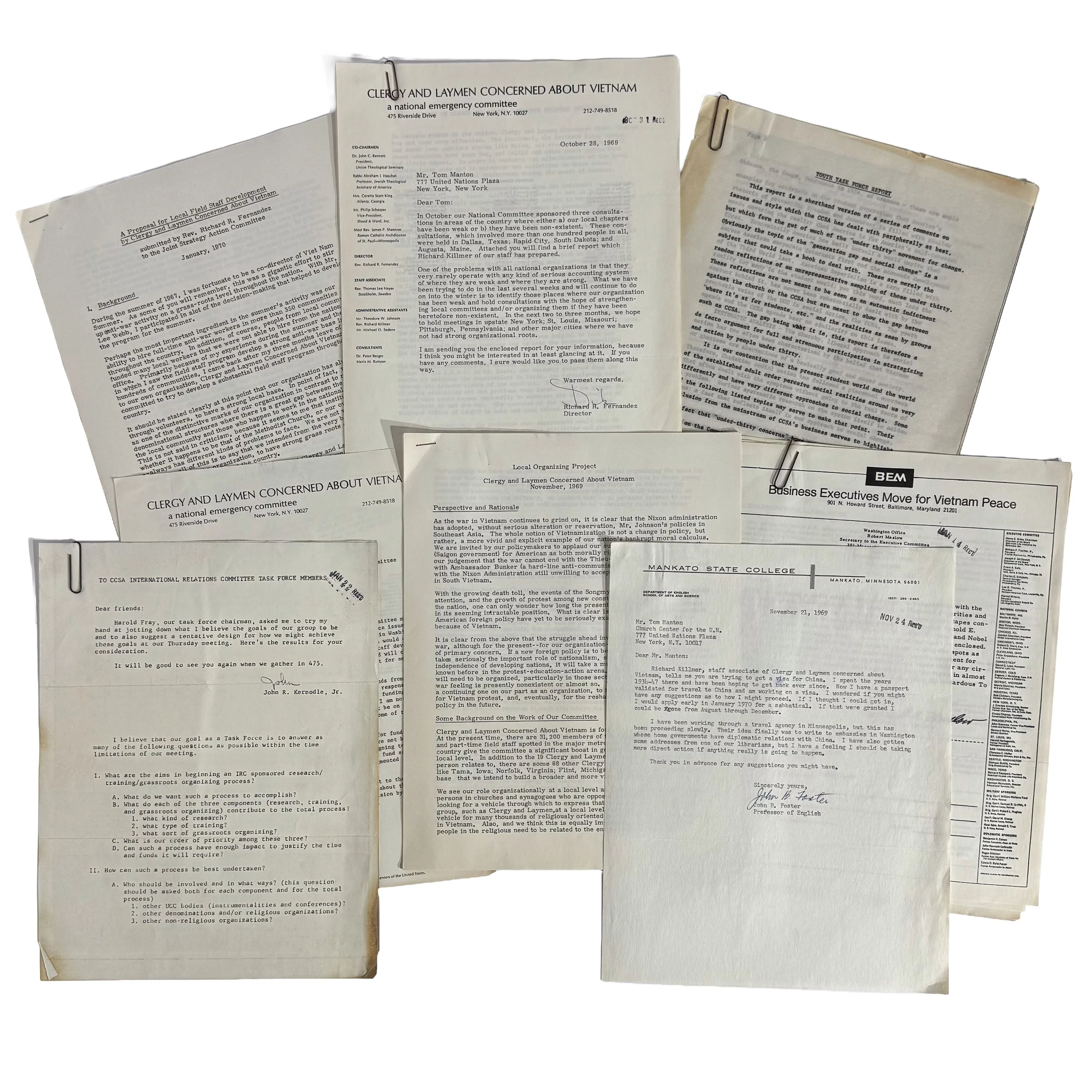 Image 1 of 14
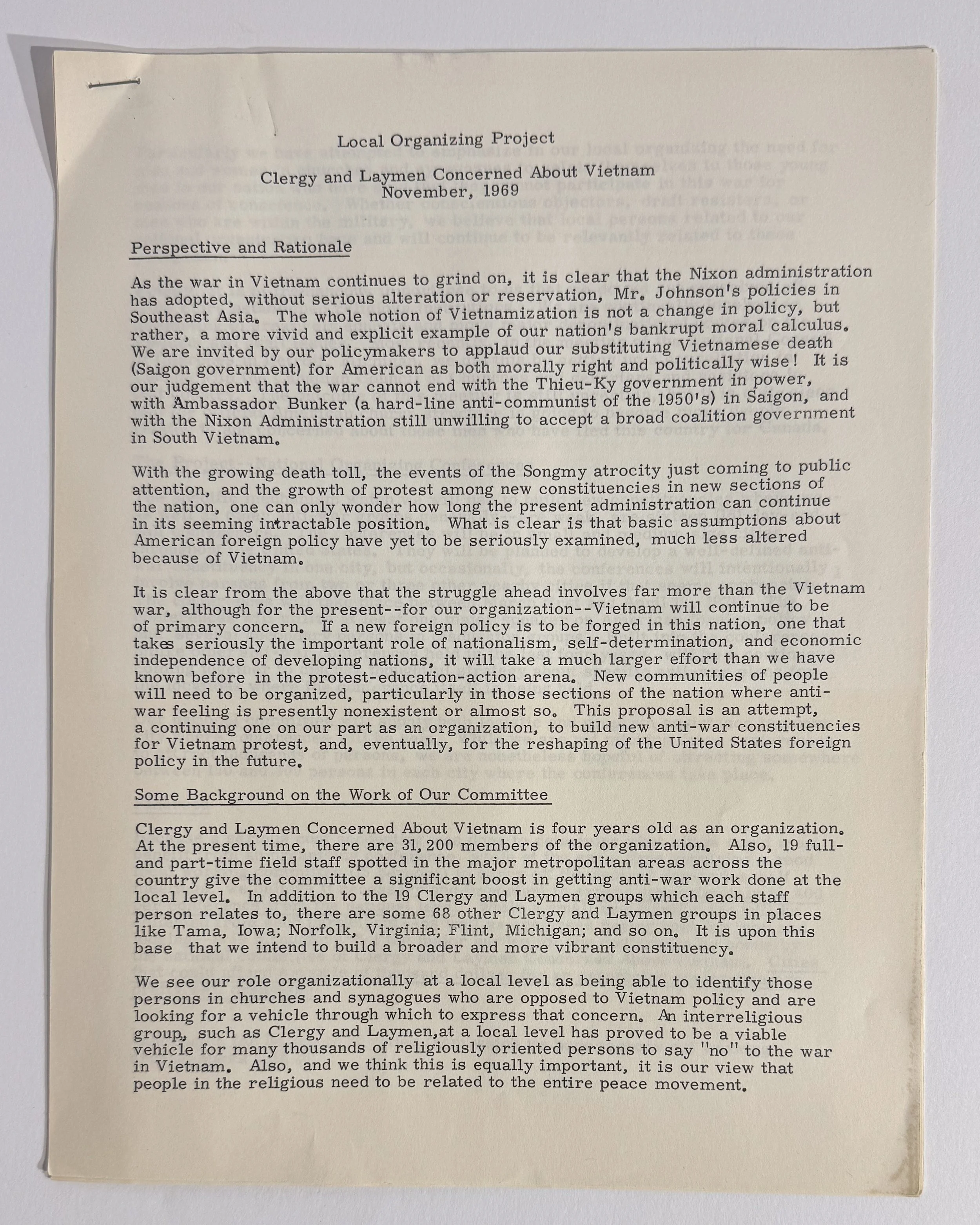 Image 2 of 14
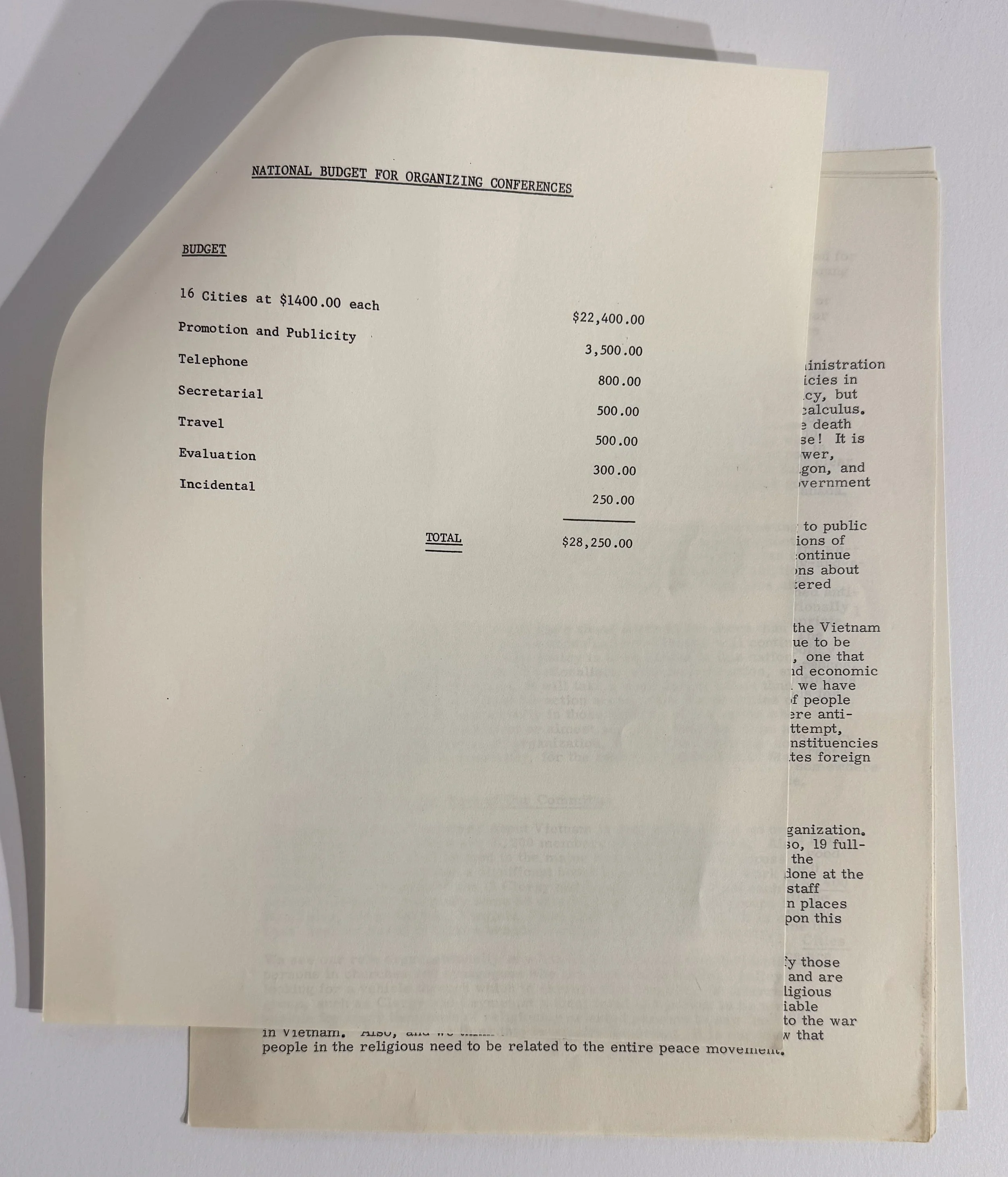 Image 3 of 14
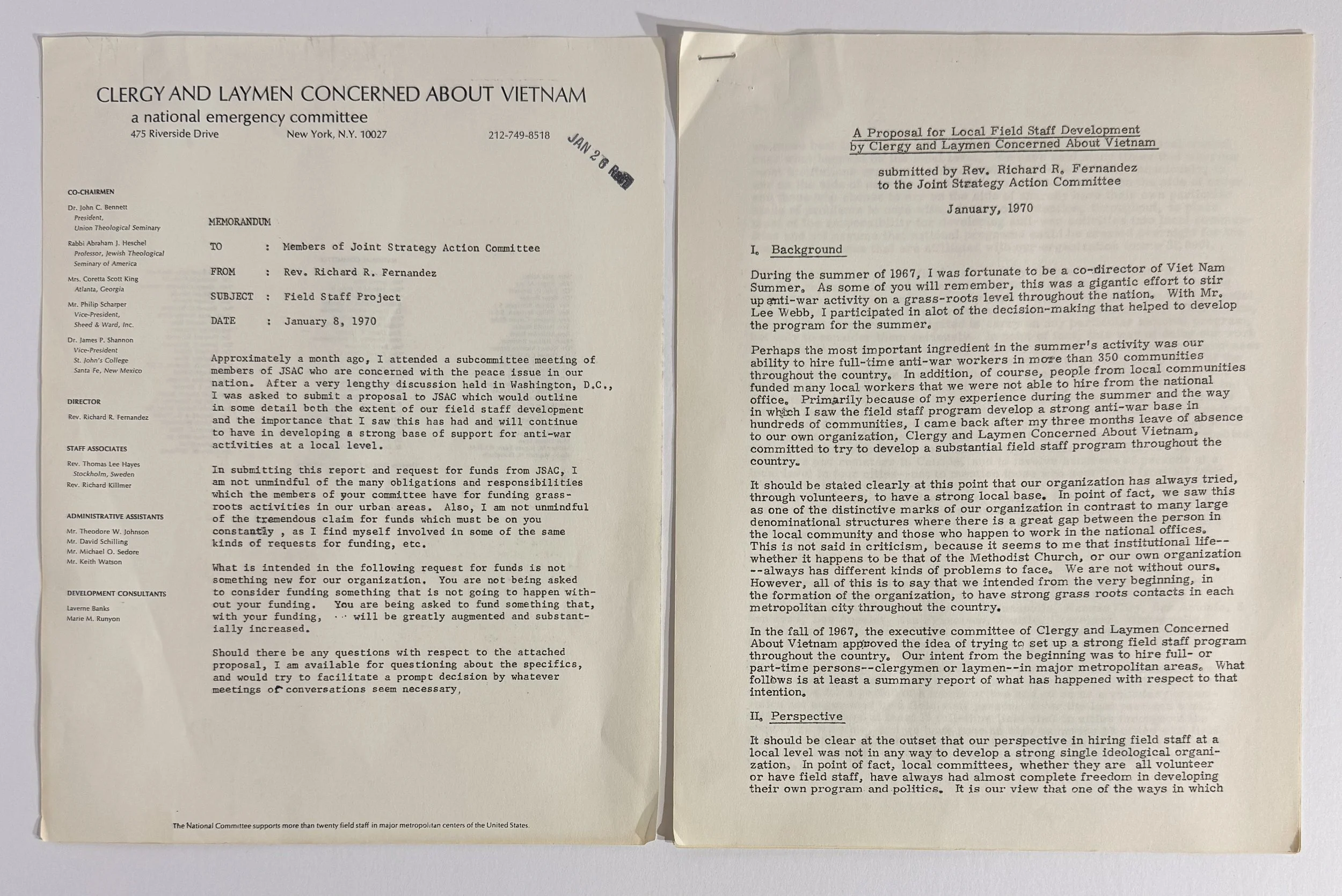 Image 4 of 14
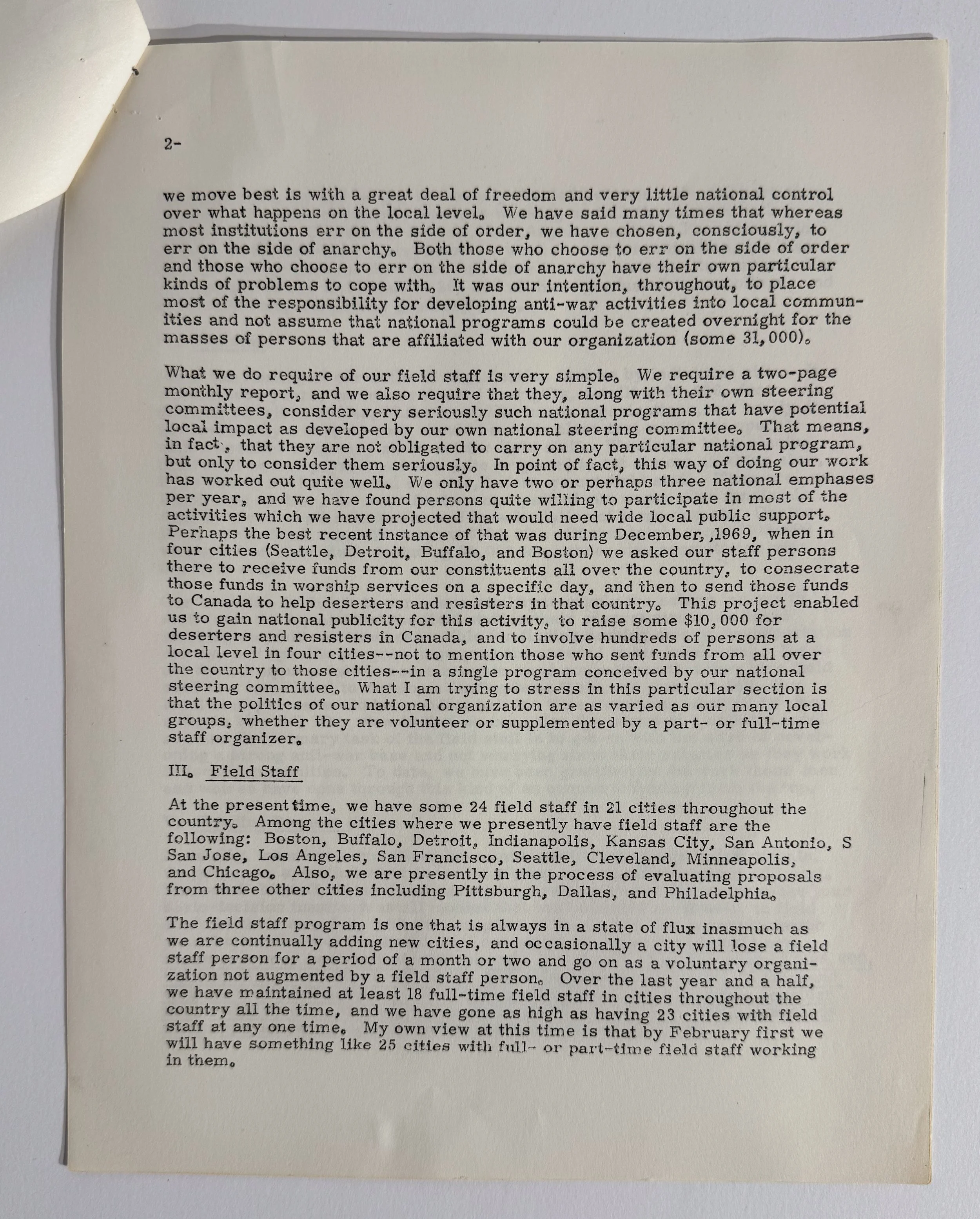 Image 5 of 14
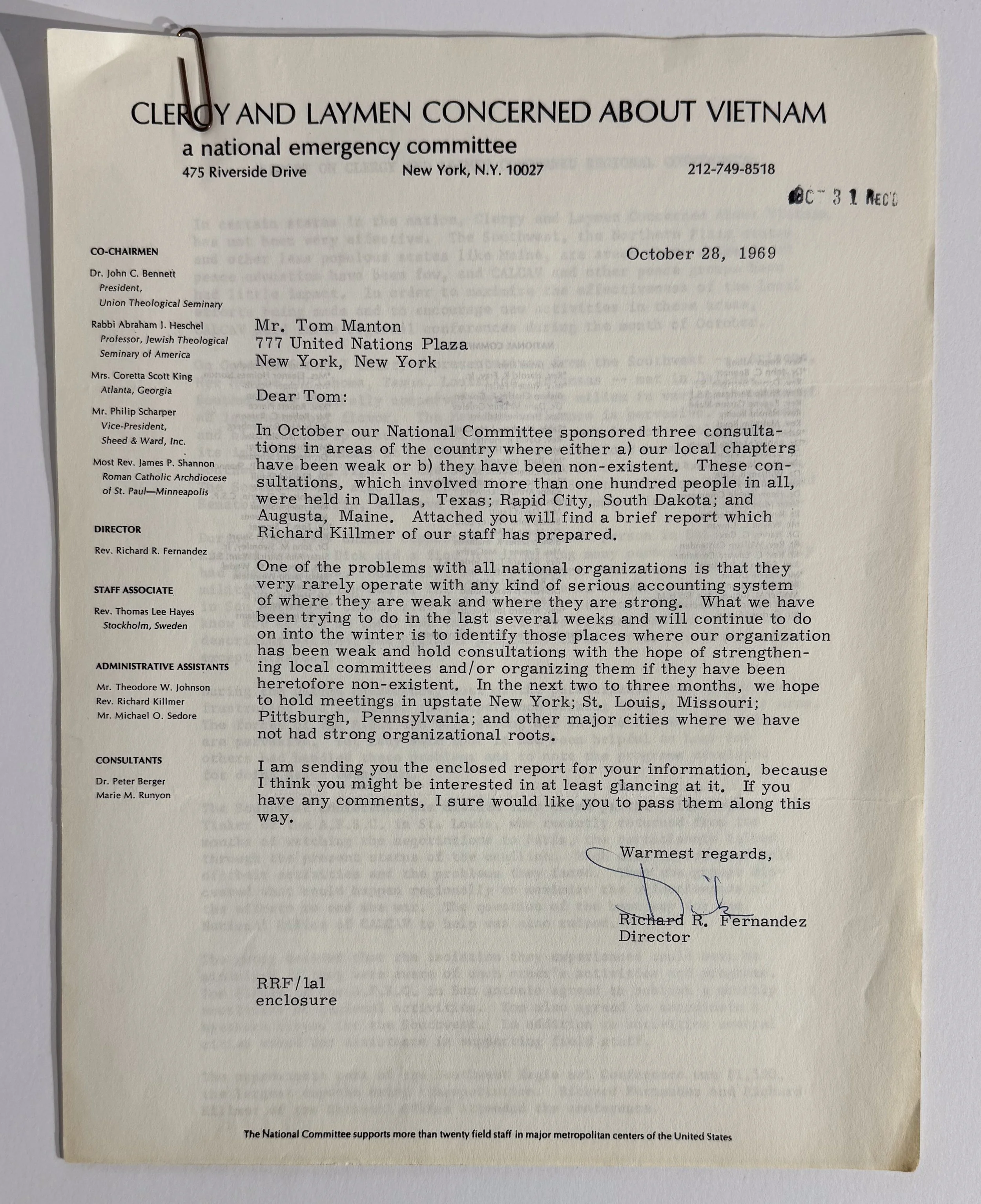 Image 6 of 14
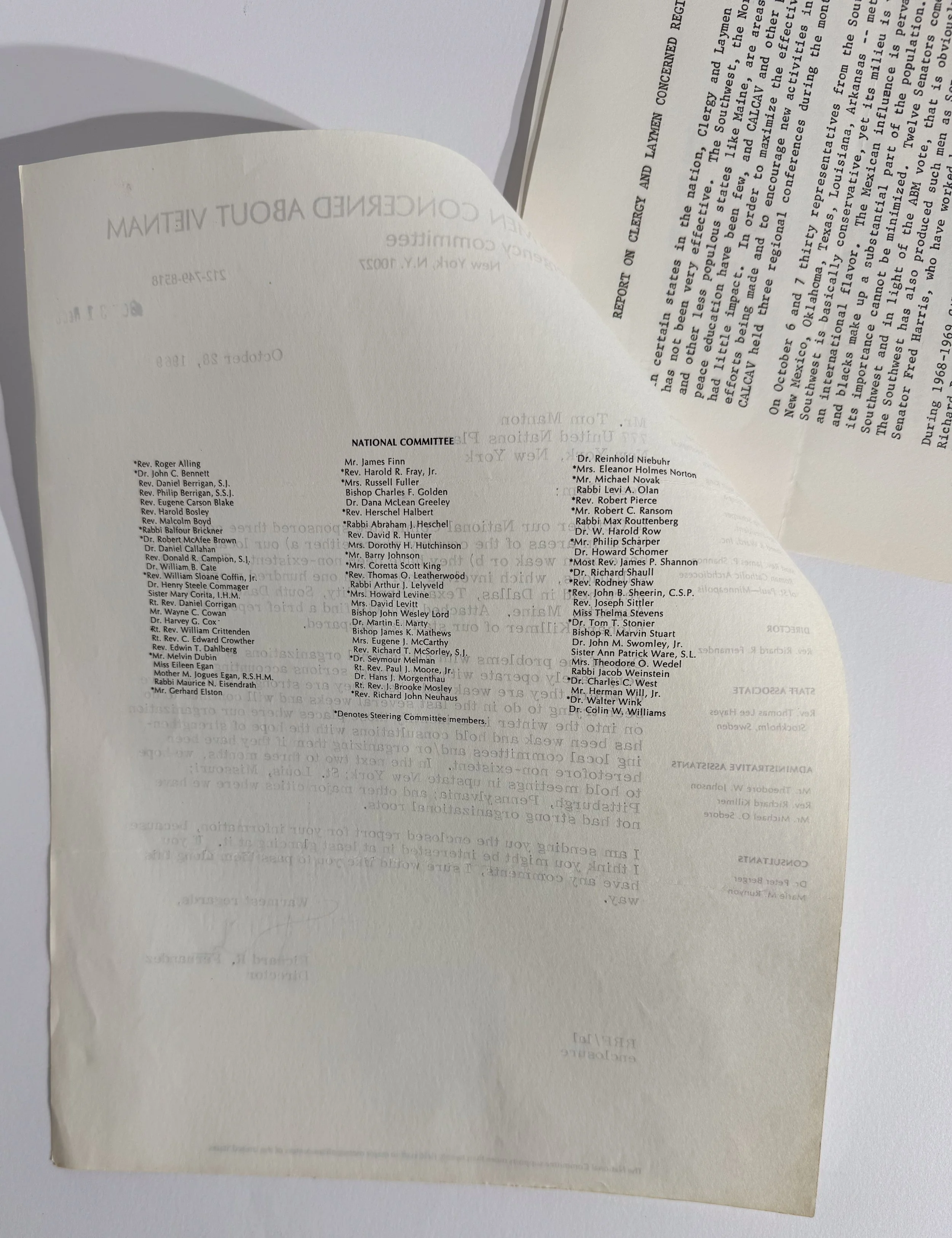 Image 7 of 14
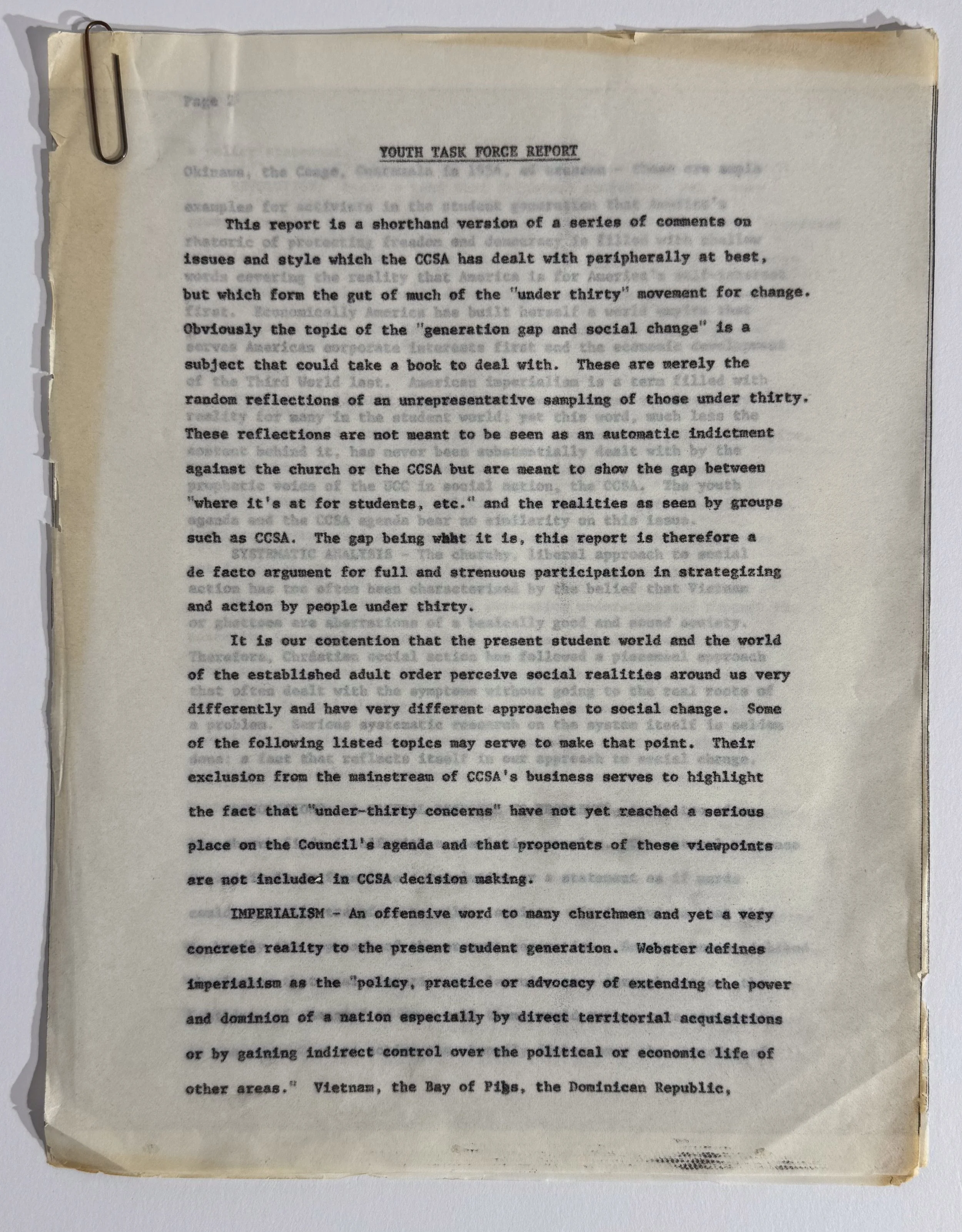 Image 8 of 14
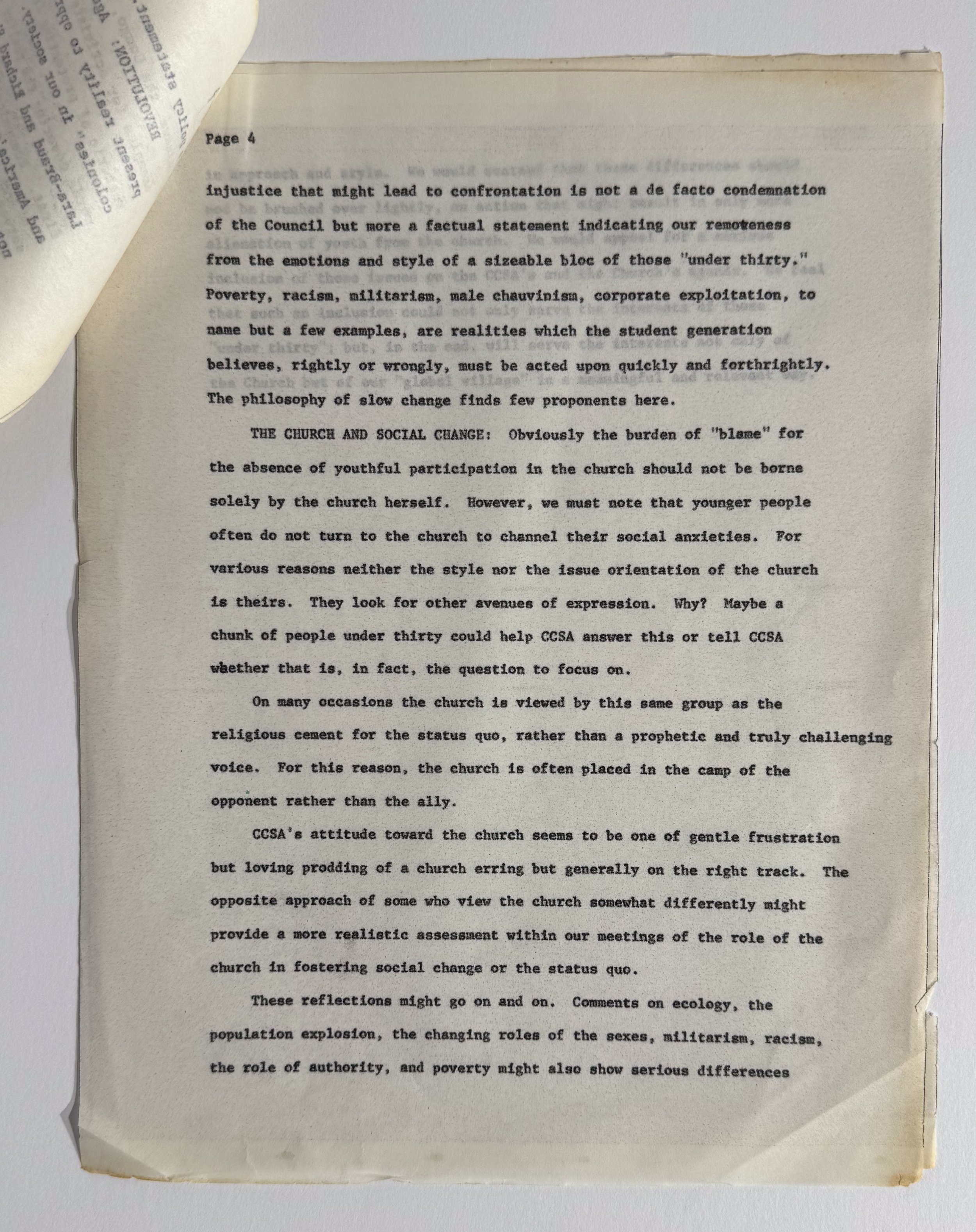 Image 9 of 14
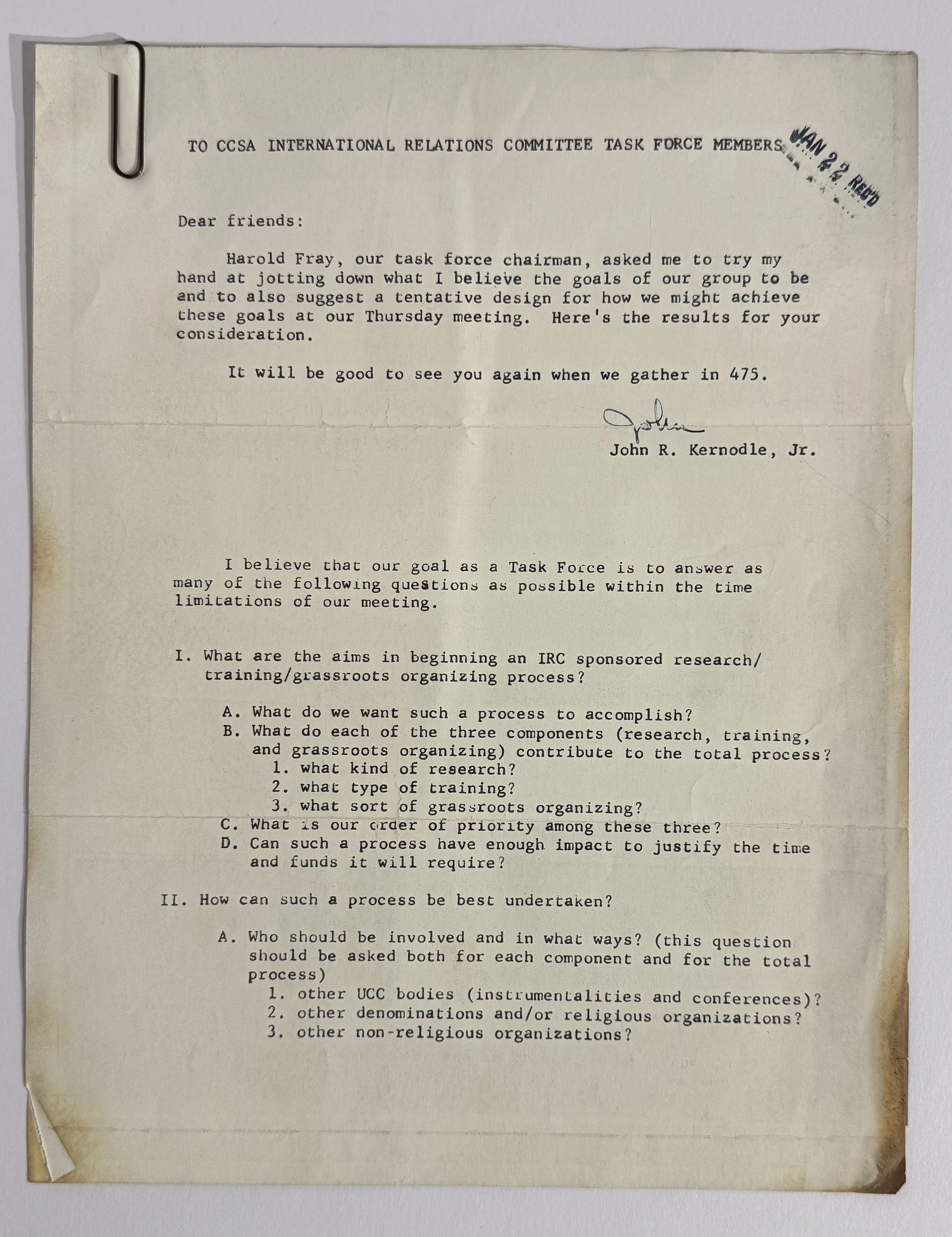 Image 10 of 14
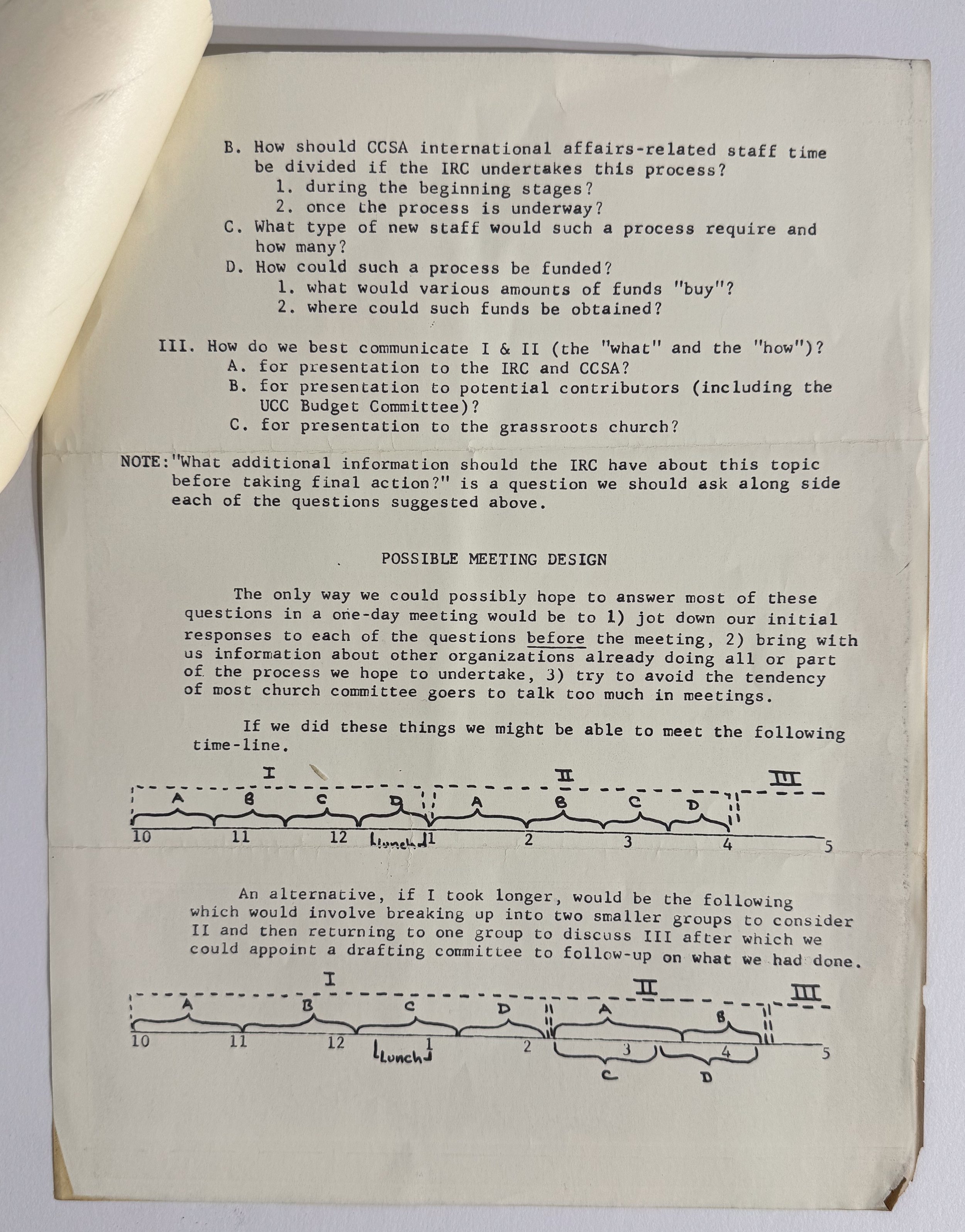 Image 11 of 14
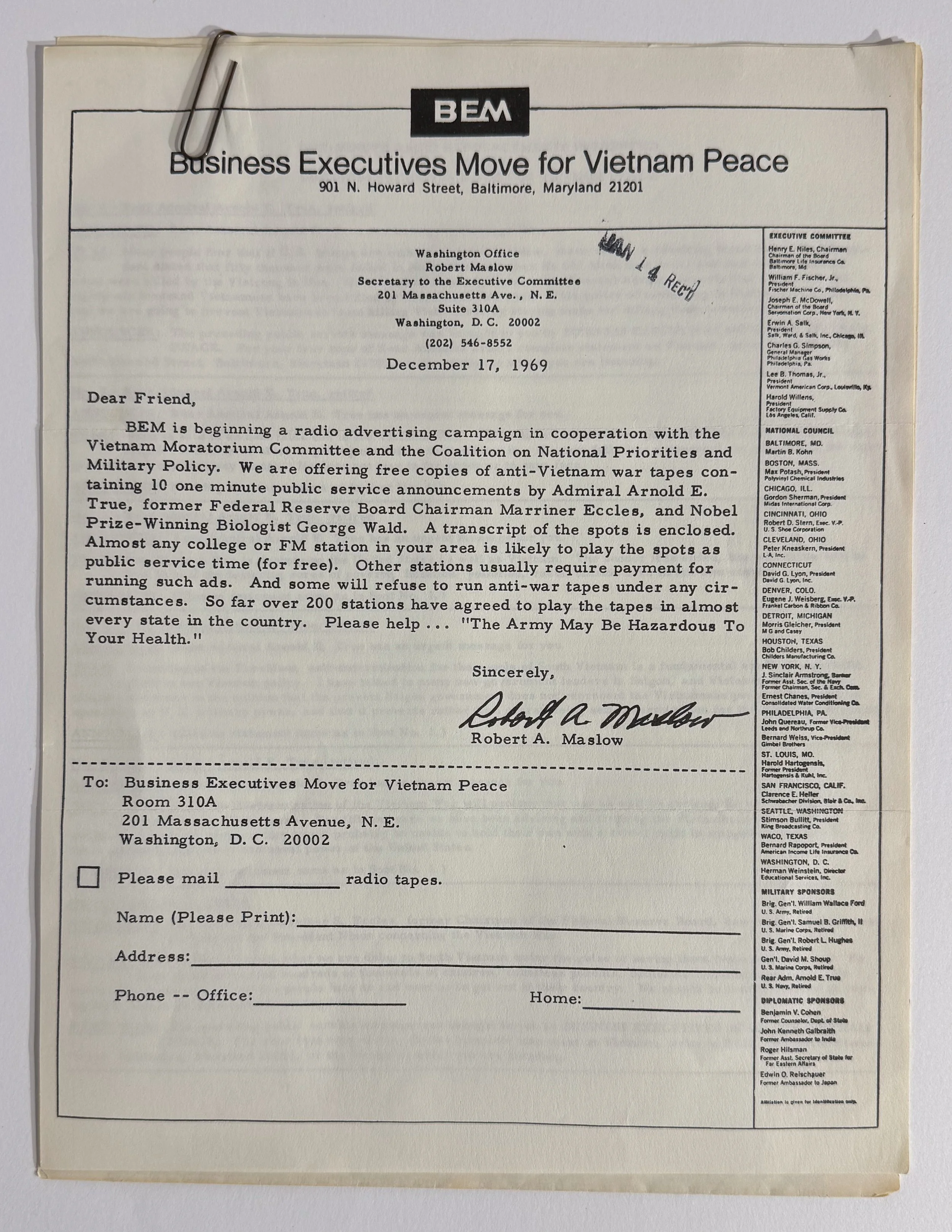 Image 12 of 14
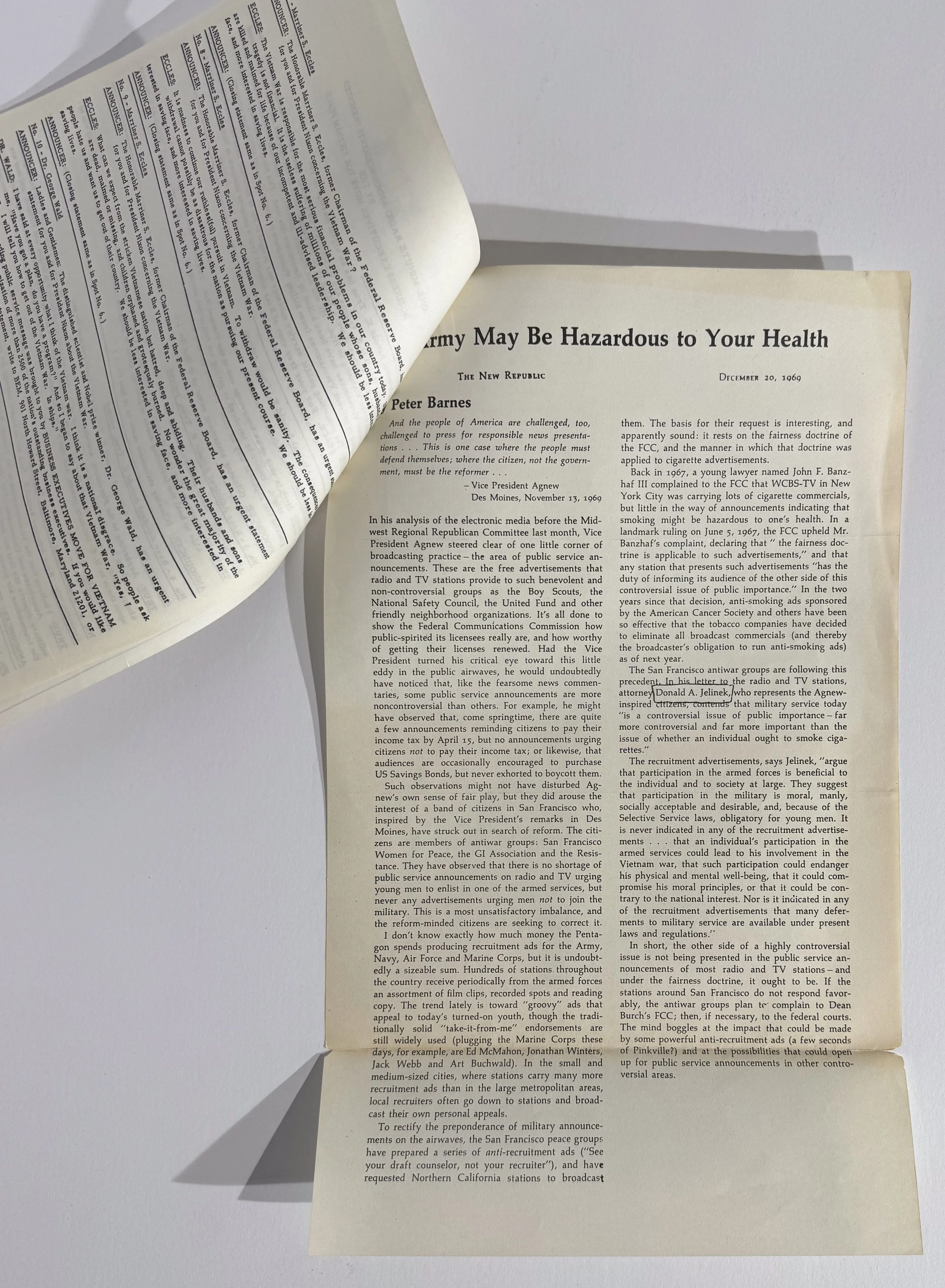 Image 13 of 14
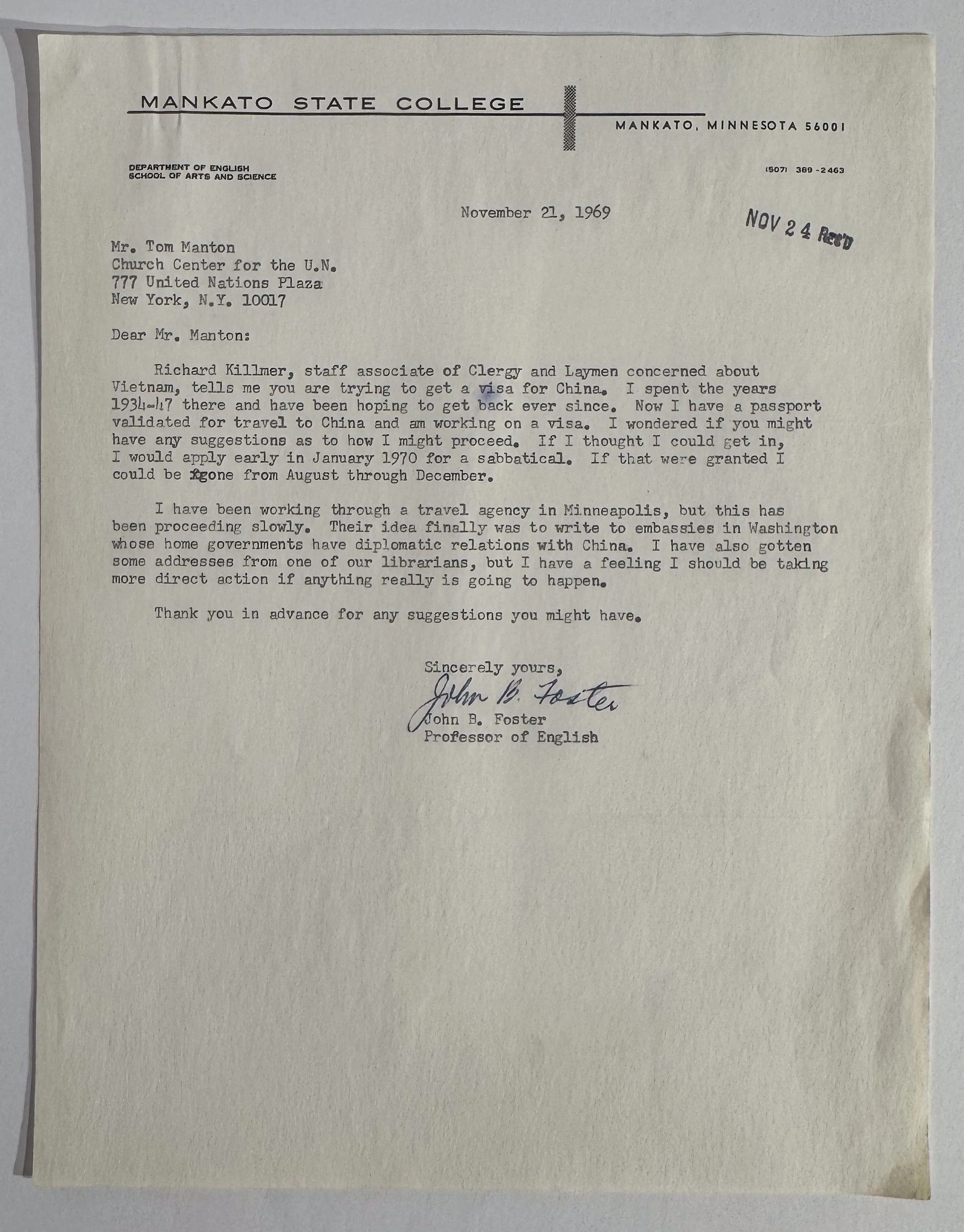 Image 14 of 14